Both BlazeSQL and LDOO let you ask questions in plain English and get answers from your data. They share the same starting point — natural language in, structured query out — but that is where the similarity ends. The difference is what sits on the other side of the query, and who the output is built for.
BlazeSQL is a query tool for data teams working with SQL databases. LDOO is a conversational analytics platform for marketing agencies working with client data. Same technique, different universes. Picking the right one depends entirely on where your data lives and what you need to do with the answer.
What BlazeSQL does
BlazeSQL connects to SQL databases — PostgreSQL, MySQL, Snowflake, BigQuery — and translates plain English questions into SQL queries. You ask "What were our top 10 products by revenue last quarter?" and BlazeSQL generates the SQL, runs it against your database, and returns the result set. It handles schema introspection, query validation, and supports multi-user access with governance controls.
The product is built for data teams. It assumes you have a data warehouse, someone who maintains it, and internal stakeholders who need answers without writing SQL themselves. Pricing ranges from $99/mo for small teams to $499/mo for enterprise deployments with audit trails, SSO, and query approval workflows.
BlazeSQL is genuinely good at what it does. If your analysts spend hours fielding ad-hoc SQL requests from product managers and executives, BlazeSQL removes that bottleneck. The governance layer — query logging, role-based access, approval chains — matters when multiple departments are querying sensitive business data.
What LDOO does
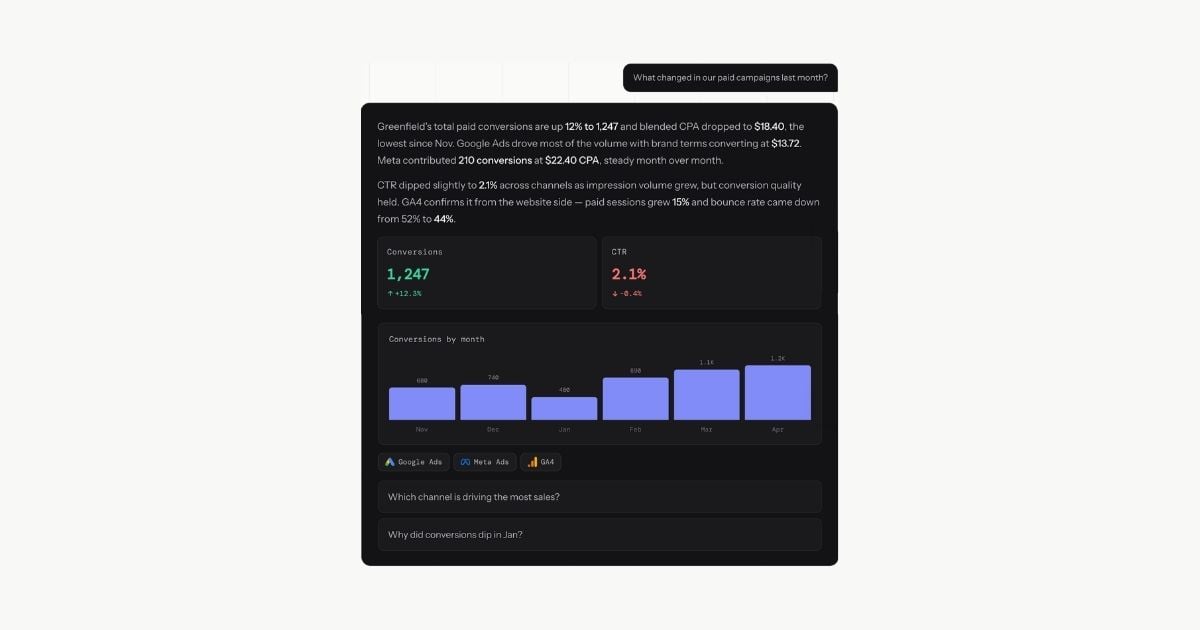
LDOO connects to marketing APIs directly — GA4, Google Ads, Meta Ads, Search Console, Shopify — and translates plain English into answers about marketing performance. You ask a question like "How did Greenfield Digital perform last month?" and LDOO returns a specific, client-ready explanation: CPA dropped 25.8% to $18.40, driven by Brand Search NZ, with mobile conversions up 14% week over week.
The difference is not just the data source. LDOO is multi-tenant by design. Every question is scoped to a specific client, every answer can be turned into a branded report or a live client portal, and the agency's branding is applied automatically. Pricing starts at $99/mo annual for 10 clients on the Launch plan, with white-label reports included.
Where BlazeSQL returns a result set that a data analyst interprets, LDOO returns an explanation that an account manager sends to a client without editing. The output is the product, not the query.
The architecture difference
This is the part that matters most, and it is the reason these two tools serve different audiences despite sharing a natural-language interface.
BlazeSQL is infrastructure-first. It needs a database you already maintain — your data warehouse, your schema, your ETL pipelines. BlazeSQL sits on top of that infrastructure and makes it queryable by non-technical users. If you do not have a centralized database with your marketing data already loaded, BlazeSQL has nothing to connect to. You would need to build the pipeline first: extract data from GA4, Ads, Meta, and Shopify, transform it into a unified schema, load it into PostgreSQL or Snowflake, and keep it updated. That is weeks of engineering work before you ask your first question.
LDOO is workflow-first. It connects to marketing APIs directly using OAuth — no database, no ETL, no schema mapping. When you ask a question, LDOO queries the APIs in real time, combines data across sources, and returns an answer. The agency connects their client's GA4 account in 30 seconds and asks a question immediately. There is no pipeline to build, no warehouse to maintain, no data engineer required.
For an agency managing 15 clients across four platforms each, the infrastructure gap is the deciding factor. Building and maintaining a data warehouse for 60+ API connections is a full-time engineering role. LDOO eliminates that role entirely. But for a company that already has a centralized data warehouse with clean, well-modeled data, BlazeSQL is the more natural fit — it meets you where your data already lives.
Side-by-side comparison
| BlazeSQL | LDOO | |
|---|---|---|
| Data source | SQL databases (PostgreSQL, MySQL, Snowflake, BigQuery) | Marketing APIs (GA4, Google Ads, Meta Ads, GSC, Shopify) |
| Setup | Connect to an existing database | OAuth connect to marketing platforms — no database needed |
| Client scoping | Not built-in (single-tenant queries) | Multi-tenant with per-client data isolation |
| Output format | Result sets, tables, charts | Client-ready explanations, branded reports, live portals |
| Governance | Query approval, audit logs, role-based access | Account-level RBAC, white-label branding, client sharing |
| Pricing | $99–$499/mo | $49–$399/mo (10–50 clients included) |
| Best for | Data teams with a warehouse | Marketing agencies with client accounts |
When BlazeSQL is the right choice
If your company has a data warehouse — or is building one — and your primary need is letting non-technical team members query it without writing SQL, BlazeSQL is a strong option. The governance features (approval workflows, query logging, SSO) matter when finance, product, and operations teams all need access to the same data with different permission levels. BlazeSQL is designed for that exact environment.
BlazeSQL also makes sense if your analytics questions span beyond marketing. Revenue data from Stripe, product usage from your application database, support metrics from Zendesk — if all of that lives in a single warehouse, BlazeSQL can query across it. LDOO is purpose-built for marketing data and does not connect to arbitrary SQL databases. If your questions are "What is our net revenue retention by cohort?" rather than "How did our Google Ads perform last week?", BlazeSQL is the better fit.
When LDOO is the right choice
If you run a marketing agency and manage multiple client accounts across Google Ads, GA4, Meta, and Search Console, LDOO is built specifically for your workflow. You do not need a data warehouse. You do not need an ETL pipeline. You connect your clients' marketing platforms, ask a question, and get an answer specific enough to paste into a client email — in seconds, not hours. From that single answer, you can generate a branded report, create a live client portal, or set up an alert. The full comparison page covers the details.
The value is not just speed — it is the output format. BlazeSQL returns data. LDOO returns explanations. For an agency where the deliverable is a client-ready narrative, not a SQL result set, that distinction is the entire product. If your team currently spends 20-60 minutes per client per month writing the narrative layer on top of dashboard data, LDOO replaces that step entirely. The evaluation framework for conversational analytics platforms covers what to look for when comparing tools in this category.