If you manage ten or more client accounts, you are spending somewhere between 20 and 60 minutes per client, every month, writing the explanation that goes around their numbers. That is up to 20 hours a month — not on strategy, not on new business, on narrative that wraps data your clients could not read on their own.
That is the problem conversational analytics software is supposed to solve. Most tools on the market do not solve it for agencies. This article explains why, and what purpose-built actually looks like.
"Conversation analytics" and "conversational analytics" are not the same
Worth clearing up quickly, because search results conflate them.
Conversation analytics analyzes how your business communicates with customers — call recordings, chat transcripts, support tickets. Gong.io and Chorus.ai are conversation analytics tools.
Conversational analytics lets you talk to your business data — marketing performance, campaign results, revenue trends — in plain English and get answers back. That is what this article is about.
For a full definition, technical breakdown, and real examples, see the complete guide to conversational analytics.
The tools everyone recommends (and what they miss for agencies)
Every roundup in this category lists roughly the same eight tools. Here is an honest look at what they are and where they fall short for agency workflows specifically.
General-purpose AI: Claude, ChatGPT, Gemini, Perplexity
These are genuinely capable tools for reasoning about data — summarizing a file you upload, explaining a trend in plain English, drafting a client summary. For those tasks, they are excellent.
The problems start when you need them to work like analytics infrastructure.
No live connections. Every session starts with a manual file export. Upload last month's Meta Ads CSV, ask your question, get an answer. Do the same next week. For agencies managing multiple clients across multiple platforms, that workflow breaks immediately — the data is stale by the time you are looking at it.
Unreliable calculations. Large language models are built to predict text, not execute queries. They can return a figure that looks plausible and is wrong. There is no audit trail. For a client report, that is not an acceptable margin of error.
No client context or isolation. These tools have no concept of "this conversation is about Client A." There is no multi-tenant structure, no persistent client history, no separation between accounts. Every session starts from scratch.
No output layer. A good answer from ChatGPT still needs to be turned into something a client can read. There is no report, no portal, no scheduled delivery. You have done half the job.
For a deeper comparison, see the ChatGPT vs LDOO comparison.
Enterprise BI: BlazeSQL, Lumenore, Knowi
These tools are more serious analytics infrastructure. They connect to data warehouses, execute real queries, and produce reliable results at scale.
BlazeSQL ($99–$499/month) converts plain English to SQL against structured databases. Useful if your data lives in a clean database and someone has configured it. Most agency stacks do not work that way. See the BlazeSQL comparison for specifics.
Lumenore and Knowi offer genuinely strong features — predictive modeling, AI-suggested follow-up questions, conversation-to-dashboard flows — but they were built for enterprise data teams, carry custom pricing, and require technical oversight to set up and maintain. See the Lumenore comparison.
None of these tools has a concept of an agency managing multiple client accounts on a marketing stack. They were designed for a single organization's internal data team, not a service business managing dozens of separate client data environments.
DataGPT, which used to appear in this category at $10,000 per quarter for a pilot engagement, shut down in late 2025. Its exit is worth noting: even at enterprise pricing, a general-purpose conversational analytics tool built without a specific buyer in mind could not sustain itself.
The gap
The tools that dominate this category are either general-purpose AI that lacks data infrastructure, or enterprise BI that requires it and then some. Neither was designed for a marketing agency.
The agency-specific requirements that fall through the gap:
- Live, OAuth-connected access to the platforms agencies actually use: Google Ads, Meta Ads, GA4, Search Console, Shopify
- Verified query execution — numbers that are right, not plausible
- Multi-tenant account isolation — Client A cannot see Client B
- Client-ready output that can go straight into a report or portal
- Pricing that works for an agency at $49–$329/mo annualnth, not $10K/quarter
How the tools compare on what actually matters
| LDOO | ChatGPT / Claude / Gemini | BlazeSQL | Lumenore / Knowi | |
|---|---|---|---|---|
| Live marketing data connectors | GA4, Google Ads, Meta, GSC, Shopify, LinkedIn Ads, more | Manual uploads only | SQL databases only | 100+ connectors, enterprise setup |
| Verified query execution | NL-to-SQL against real data, AI interprets results | LLM approximation | SQL generation | Yes |
| Client isolation (multi-tenant) | Per-client RLS | No | No | Partial |
| Client-ready output | Reports, portals, scheduled delivery | No | No | Enterprise dashboards |
| No technical setup | Yes | Yes | Requires DB configuration | Requires analyst setup |
| Agency pricing | From $99/mo annual | $20/mo (no data infra) | $99–499/mo (no agency features) | Custom enterprise |
| White-label branding | All paid plans | No | No | No |
What purpose-built means in practice
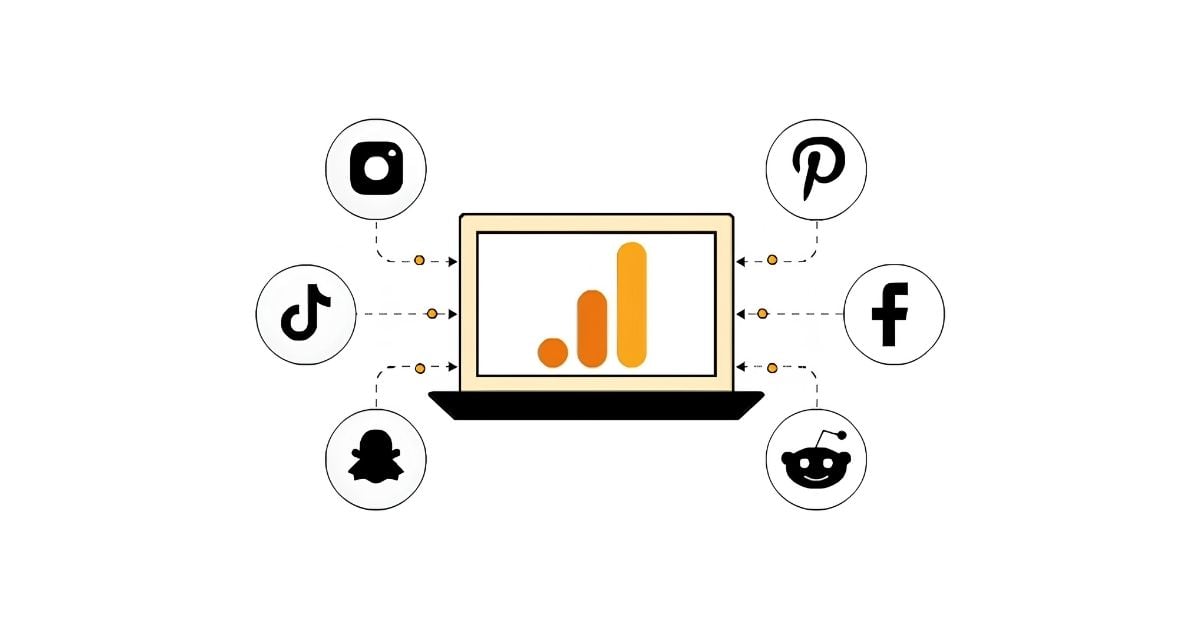
Live data from the sources agencies use. LDOO connects directly to GA4, Google Ads, Meta Ads, Google Search Console, Shopify, YouTube Analytics, Microsoft Clarity, LinkedIn Ads, and Google Sheets via OAuth. No CSV exports. No manual refreshes. When you ask a question, the answer comes from current data.
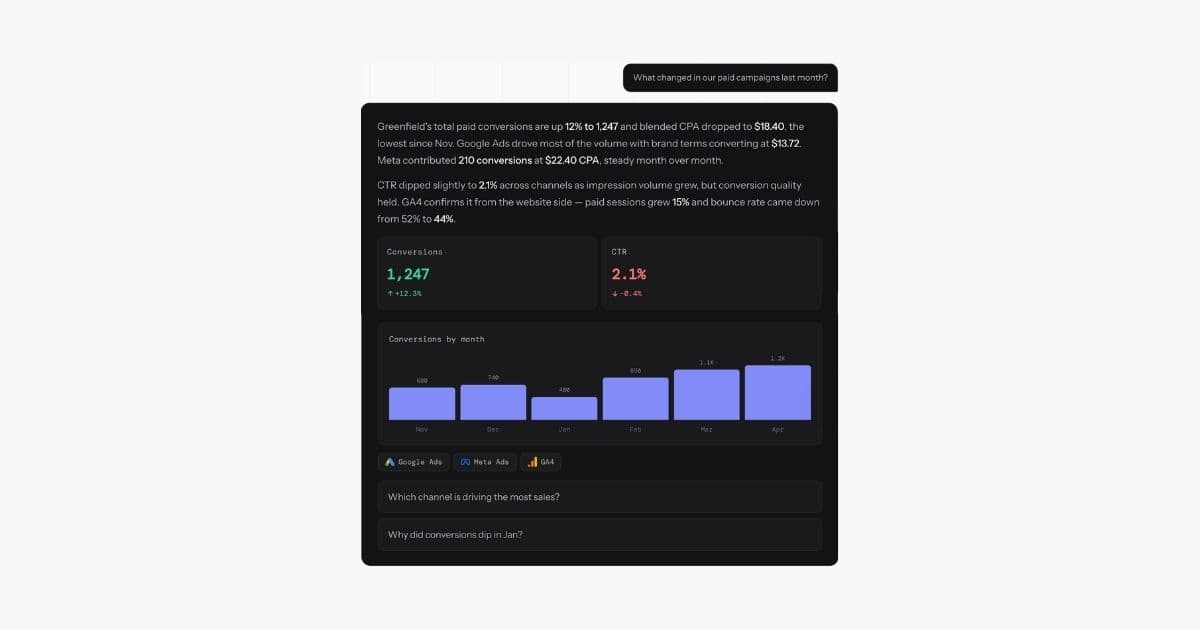
Verified query execution. LDOO does not ask an AI to estimate your client's click-through rate. It generates a query, runs it against the actual data, and passes the verified result to the AI for interpretation. The number is right because it came from the database. The query is shown alongside every answer — you can see exactly what was asked of your data and verify the interpretation. For a technical deep-dive on this pipeline, see how conversational analytics works inside LDOO.
Multi-tenant architecture. Every client account is isolated. The conversation about Client A's Google Ads performance has no access to Client B's data. That is a hard architectural constraint.
Conversation-to-portal output. Answers become client portals — branded, live, shareable — in one click. One-click reports with AI-written narrative handle the delivery layer. Proactive alerts surface anomalies and milestones before clients ask. Scheduled reporting sends fresh narrative and numbers on a set cadence without manual work.
No technical setup required. Connect your accounts, start asking questions. No data warehouse, no SQL, no configuration.
For a deeper look at how the query pipeline works, see how LDOO works.
The ROI for agencies
The math is straightforward. A typical account manager spends 20–60 minutes per client, every month, writing the narrative that wraps the numbers. For a 20-client agency, that is 7–20 hours a month — purely on explanation, not strategy.
LDOO compresses that to 30 seconds per report. Ask the question, generate the report, send it. The recovered time — 7 to 20 hours — goes back into strategy, new business, or running more accounts at the same headcount.
That is what makes agency-specific pricing matter. At $99/mo annualnth for 10 clients, the tool pays for itself in the first hour it saves you.
What LDOO does not do yet
Honest comparison means acknowledging gaps.
Predictive analytics. Lumenore and Knowi both highlight forecasting as a differentiator. LDOO explains what happened; it does not yet predict what will happen. For the core agency workflow — client reporting, performance analysis, campaign review — that is not a blocker today. It is on the roadmap.
Broader connector coverage. LDOO covers the platforms that drive the majority of agency revenue: Google Ads, Meta, GA4, Search Console, Shopify. TikTok Ads and HubSpot are not connected yet. If your agency is heavily weighted toward those channels, that is worth knowing before you sign up.
How to evaluate conversational analytics software
The comparison table and category breakdown above give you the landscape. For a structured framework on testing data accuracy, checking client isolation, and scoring output quality during a trial, read the full evaluation guide for conversational analytics platforms. For how agencies apply this day-to-day, see the agency workflow guide.
The short version: connect your real data during the trial. Ask a question you already know the answer to. If the tool gets it wrong, or if the answer requires significant editing before you could send it to a client, move on.